'Red Bag' Delivery
Dr Fiona M Lacey
IntroductionIn a normal foaling the first thing you will see is the whitish membrane (amnion) which surrounds the foal. On the rare occasion that there has been placental separation (the placenta has detached from the uterine wall prematurely) it is a foaling emergency and you must act quickly.
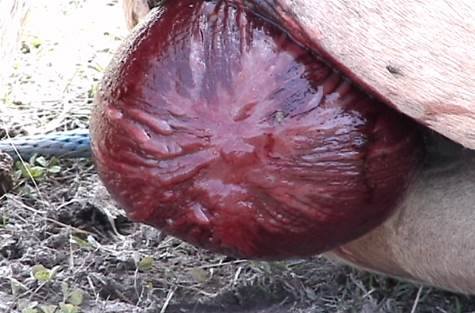
A red bag foaling – an emergency!
What Does Red Bag Mean?
In a normal birth the foal is still getting oxygen from the mare’s blood supply (across the placenta) right until the moment its chest clears the pelvis and it takes its first breath. As the mares uterus starts to contract the increased pressure causes the allantochorion (placenta) to rupture at the cervical star, releasing a rush of allantoic fluid (‘waters breaking’) and the placenta remains attached, supplying the foal with oxygen during the foaling process.
In a ‘red bag’ delivery the placenta has partially or completely separated from the mares endometrium (lining of the uterus) prior to the foal being delivered. This means that the foal is getting no oxygen from the time of separation (or reduced oxygen in the case of partial separation) to the time it is delivered. Obviously the longer the time frame, the more compromised the foal will be. If too much time has elapsed the foal will be born dead.
What Should You Do?
You vet will not get to you in time! If there is an extra person call your vet and get them on their way but you need to act immediately to save your foal.
Rupture the placenta, either with your fingers or a pair of scissors, find the front feet and pull! As the feet and head come out adjust your angle so you are pulling down towards the hocks. This is not something I would recommend in a normal foaling but it is imperative you get this foal out as quickly as possible.
Once the foal is out check if it’s breathing and feel for a heartbeat. If it has no heartbeat you can do chest compressions, while a second person gives it respiratory support. If there is a heartbeat but it is not breathing, use oxygen (if available), a resuscitator (if you have one) or close its mouth and block off one nostril with one hand and breath deeply and vigorously into the remaining nostril. Once you can detect a heartbeat (it may still be slow at this stage) rub its chest vigorously, sit in in sternal recumbency (upright on its chest - not laying on its side) and continue to closely monitor it until your vet arrives.
What Next?
Many of these foals have some degree of compromise and they may be ‘dummy’ foals. You need to continue to monitor the foal carefully for the next 48 hours as sometimes a foal that appears normal at birth can develop dummy symptoms over time. Referral to a hospital with the facilities to care for a neonate is often a sensible option.
What Causes It?Placentitis is one of the most common causes, but it can also occur with some toxicities. Sometimes we don’t know the cause. Many mares have had several normal foalings and then a red bag, and vice versa, just because a mare had one red bag doesn’t mean she will do so again.
Conclusion
In a normal birth the foal is still getting oxygen from the mare’s blood supply (across the placenta) right until the moment its chest clears the pelvis and it takes its first breath. As the mares uterus starts to contract the increased pressure causes the allantochorion (placenta) to rupture at the cervical star, releasing a rush of allantoic fluid (‘waters breaking’) and the placenta remains attached, supplying the foal with oxygen during the foaling process.
In a ‘red bag’ delivery the placenta has partially or completely separated from the mares endometrium (lining of the uterus) prior to the foal being delivered. This means that the foal is getting no oxygen from the time of separation (or reduced oxygen in the case of partial separation) to the time it is delivered. Obviously the longer the time frame, the more compromised the foal will be. If too much time has elapsed the foal will be born dead.
What Should You Do?
You vet will not get to you in time! If there is an extra person call your vet and get them on their way but you need to act immediately to save your foal.
Rupture the placenta, either with your fingers or a pair of scissors, find the front feet and pull! As the feet and head come out adjust your angle so you are pulling down towards the hocks. This is not something I would recommend in a normal foaling but it is imperative you get this foal out as quickly as possible.
Once the foal is out check if it’s breathing and feel for a heartbeat. If it has no heartbeat you can do chest compressions, while a second person gives it respiratory support. If there is a heartbeat but it is not breathing, use oxygen (if available), a resuscitator (if you have one) or close its mouth and block off one nostril with one hand and breath deeply and vigorously into the remaining nostril. Once you can detect a heartbeat (it may still be slow at this stage) rub its chest vigorously, sit in in sternal recumbency (upright on its chest - not laying on its side) and continue to closely monitor it until your vet arrives.
What Next?
Many of these foals have some degree of compromise and they may be ‘dummy’ foals. You need to continue to monitor the foal carefully for the next 48 hours as sometimes a foal that appears normal at birth can develop dummy symptoms over time. Referral to a hospital with the facilities to care for a neonate is often a sensible option.
What Causes It?Placentitis is one of the most common causes, but it can also occur with some toxicities. Sometimes we don’t know the cause. Many mares have had several normal foalings and then a red bag, and vice versa, just because a mare had one red bag doesn’t mean she will do so again.
Conclusion
- Always monitor your mares as they get close to foaling. You can hire foaling alarms or send her to a reputable foaling down centre.
- Have your foaling kit ready and prepared.
- Make sure you know normal and can recognise a red bag delivery
- Get the foal out as quickly as possible
- Make sure both mare and foal are checked out by your vet.